
Task Mastery for High Performance Entrepreneurs
Being an entrepreneur, you are obliged to deal with everything that you can possibly imagine whether it is related to your business or not, starting from the very first stage of your career.
EDUCATION
Dezmon
11/27/20255 min read


As an employee, your main objective is to carry out tasks assigned by your superiors. Although it can be overwhelming to a certain point, it can never compete with the task responsibilities an entrepreneur has to experience. For an entrepreneur, you are obliged to deal with everything that you can possibly imagine whether it is related to your business or not, starting from the very first stage of your career.
Having chosen entrepreneurship as your career, you are now a sole decision maker with endless streams of workloads. Everything seems to be equally important to you, which makes you confused about what the top priority is. Such a situation can make you feel completely overwhelmed every now and then. If you are already in this situation, it is definitely the time you need to look for some assistance.


General Tips On Task Management
There are people adept at managing work schedules effectively. For example, Josh Kohlbach, CEO and founder of Rymera Web Co, suggests that we make use of technology to reduce time spent on a particular task. This applies to tasks that can be done by automation such as social media posts, marketing emails, or appointment reminders, etc.
Setting time limits also works well with high performance entrepreneurs, especially for unplanned events. Doing so will save a lot of time for you while improving your productivity. But be mindful that you don’t hold yourself back by multi-tasking and always focus on one thing at a time.
In addition to that, Young Entrepreneur Council (YEC) members offer ways to maximize the limited time. The first tip is to write out the most important thing to finish on that day on the paper. You have to know when you should play and when you should work.
Entrepreneurs with high performance suggest building up momentum by completing something easy in the morning and work on the more challenging tasks in the afternoon. It is better to do the right task at the right time.
The last useful tip is to apply the 80/20 rule. It means that 20 percent of your performance should account for 80 percent of the results. For example, if there are 10 things to do on the day, try to choose 2 out of them that will produce the most meaningful results.
These suggested techniques are obviously useful. However, the following problem is that sometimes you do not know where to begin at all even though you realize that you need to prioritize tasks. To troubleshoot this situation, we suggest the TaskRank framework as the starting line. With TaskRank applied, you will be able to handle things on your plate more effectively.
Introducing TaskRank Framework
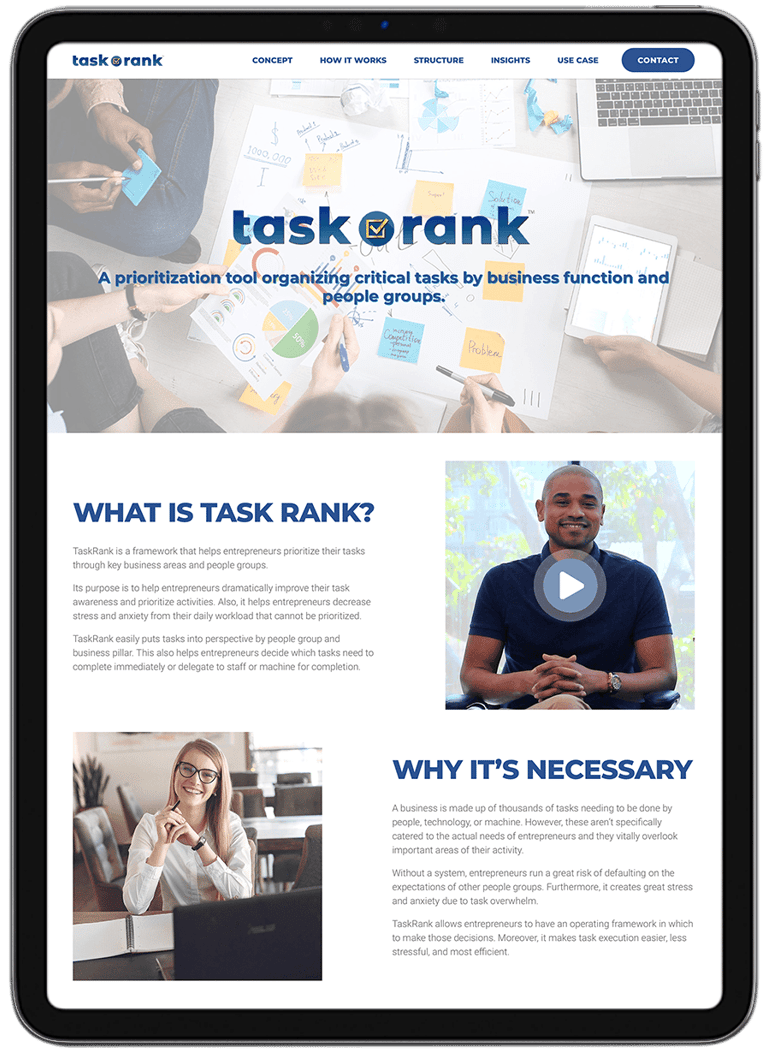
TaskRank is a task prioritization tool for high performance entrepreneurs. Created by Dezmon Landers, the tool helps entrepreneurs prioritize their tasks by connecting activities with their relevant groups of people. In this way, the framework gives you a clear overview of all tasks, allowing you to decide the priority of your activities from an objective viewpoint. Accordingly, you will be able to fulfill the needs and expectations of all stakeholders, thus freeing you from stress and anxiety. The TaskRank framework is based on 5 key pillars as follows:
1. People Groups: To begin with, you should categorize the groups of people you interact with based on relevant tasks. From our study, we found that an entrepreneur can work with up to 15 different groups of people. To that end, we can divide them into three categories, each consists of 5 different groups:
Social: The group of people you meet during your personal life, this includes your spouse, family, friends, associates, as well as strangers
Operations: People who are connected to you through direct contributions of your business. This involves owner(s), employees, customers, suppliers, and contractors
Organizational: They are the parties that exist outside of your business but can affect your direction and operations, including government, competitors, business partners, community, and media.


4. Delivery: Helps you identify any task relevant to the management of the company’s people and resources. For example, to keep track of your employees’ happiness, you request for a software that delivers the customer satisfaction report on a monthly basis. This task goes into this pillar.
5. Exit: Traditionally, most enterprises complete their business functions with the product or service delivery. The last category goes beyond this. Exit encourages you to carry out tasks associated with the smooth separation of resources and people from your business such as after-sale services. In this way, all relevant stakeholders are likely to be more satisfied. This creates the opportunity to do business with them again in the future.
After identifying tasks and linking them with relevant groups of people, you can then set the priority on critical tasks that can create bottlenecks and dependencies for your operations, in other words, focus on finishing the tasks that will stop other tasks from proceeding. This way you will be able to fully and efficiently utilize your time to finish as much work as possible within the given time frame.
Conclusion
With a lot of activities and parties involved in task management, entrepreneurs often get lost in the business maze. Sometimes tips and tricks suggested by professionals do not help much as they are not relevant to your situation. This is why you need a comprehensive tool like TaskRank that can help you organize your plan objectively. By using the framework, you can create a task overview from the list of all relevant people and connect them to particular tasks. This allows you to see the critical tasks that need to be prioritized. Mastering the task management skills and becoming a high performance entrepreneur will become possible for you.
2. Foundation: This step aims to link particular tasks with the core components of your business infrastructure, before matching them with People Groups. For example, you might be looking for a supplier. But before you begin the search you have set up a supplier agreement beforehand, which involves sales presentation and contract drafts from both the sales and legal department of your firm. These kinds of tasks fall under the foundation category.
3. Acquisition: The third pillar is about tasks related to acquiring new resources for your business. This covers both human and non-human resources. Suppose you are looking for some financial capital, but you do not want to source the fund from a bank. Instead, your business partners are the main focus. The activities related to capital acquisition from your partners such as terms negotiation and pitching will go into this category.
Copyright © 2025 Dezmon Landers